
Floating Policy under Fire Insurance: One Policy, Multiple Locations, Complete Protection
A Floating Policy in Fire Insurance offers businesses a smart and flexible way to protect their stock across multiple warehouses, factories, and storage locations under a single sum insured. Instead of managing separate policies for every premises, businesses can enjoy simplified insurance management and better utilisation of coverage as stock moves between declared locations. Discover how floating policies work, their key benefits, real-world applications, and why choosing the right fire insura
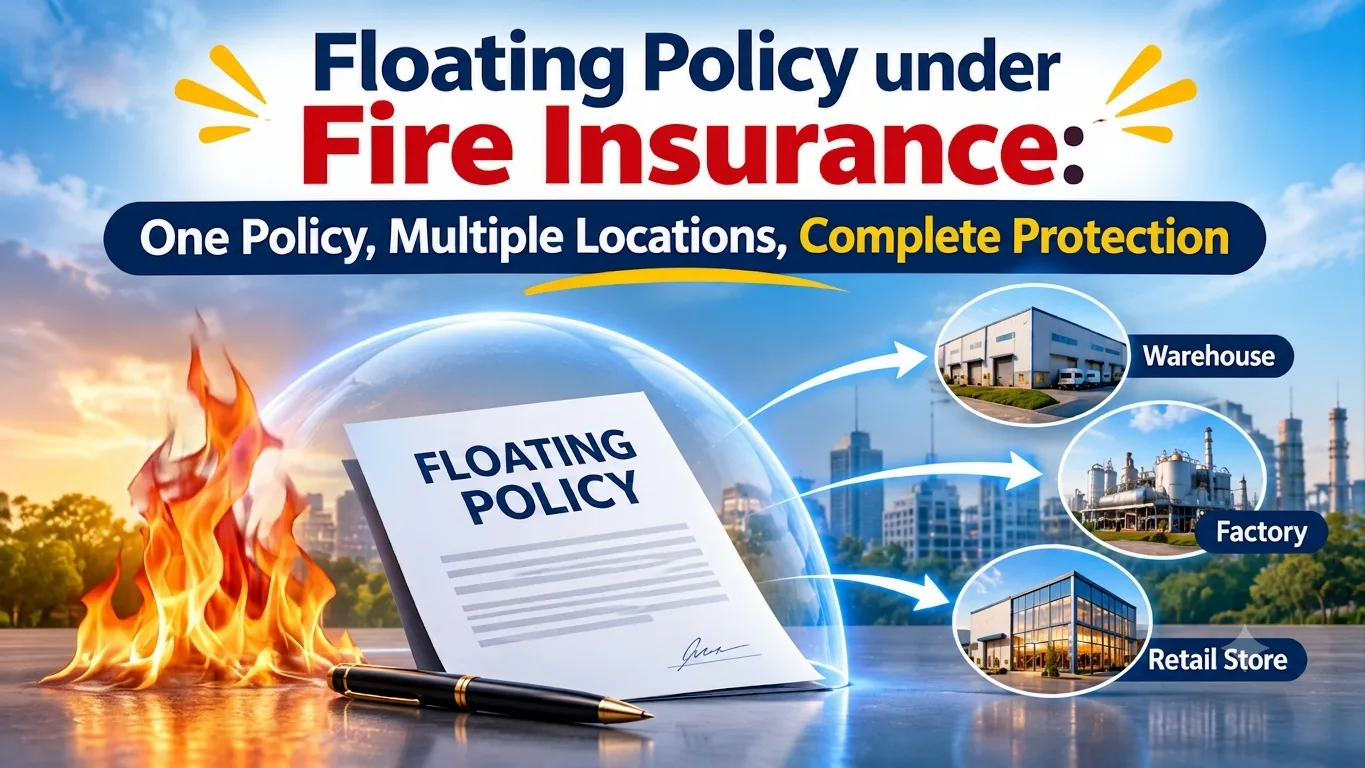
Floating Policy
In today’s fast-moving business environment, companies often operate from multiple warehouses, factories, godowns, and storage facilities. Their stock and goods may frequently move from one location to another depending on customer demand, production requirements, and supply chain operations. Managing separate fire insurance policies for every location can become complicated, especially when stock quantities and values keep changing.
This is where a Floating Policy in Fire Insurance becomes an effective insurance solution. It offers businesses the convenience of insuring stock and assets spread across multiple locations under a single policy with a consolidated sum insured. Instead of maintaining separate insurance policies for every premises, businesses can manage their fire insurance coverage through one comprehensive arrangement.
Let's understand what a floating policy is, how it works, its benefits, and why businesses with multiple locations should consider it.
What Is a Floating Policy in Fire Insurance?
A floating policy is a type of fire insurance policy that provides coverage for stocks or assets located at multiple insured premises under a single sum insured.
Unlike a standard fire insurance policy, which generally covers property at a specified location, a floating policy allows businesses to cover eligible stocks distributed across different locations under one consolidated insurance amount.
For example, imagine a company operating three warehouses in Chennai, Coimbatore, and Bengaluru. Instead of purchasing three separate fire insurance policies, the company can opt for a floating policy covering the stock across all three locations under a combined sum insured.
If the total value of the stock across these locations is ₹1 crore, the company can arrange a floating policy for the same consolidated amount, subject to the policy's terms and conditions.
This provides flexibility when stock quantities vary from one location to another.
Are You Sure All Your Goods Are Protected?
A floating policy works by combining the insured values of multiple declared locations under one overall sum insured.
Consider a manufacturing company that stores its products in three different warehouses.
- Chennai Warehouse – ₹40 Lakhs
- Coimbatore Warehouse – ₹30 Lakhs
- Bengaluru Warehouse – ₹30 Lakhs
The total stock value is ₹1 crore. Instead of taking individual policies for each warehouse, the business can obtain a floating fire insurance policy with a consolidated sum insured of ₹1 crore.
As stock moves between these locations, the business can manage its insurance coverage without having to purchase a separate policy every time stock distribution changes.
However, all locations must be properly declared and covered under the policy. The flexibility offered by a floating policy does not mean that businesses can automatically include any new or undisclosed location. The applicable policy conditions, declaration requirements, and geographical restrictions must be followed.
How Could a Floating Fire Insurance Policy Have Helped a Manufacturer?
An interesting example of the importance of floating fire insurance can be seen in the case of a Jute Bag Manufacturer at Gujarat, decided by the Gujarat High Court on 15 September 2021.
The industry was a partnership firm engaged in the business of manufacturing and trading jute bags in Dahod, Gujarat. Initially, the company operated from a single godown and maintained a standard fire insurance policy covering the stock stored at that particular location.
The company obtained its first floating policy in 2001, covering stock across all three godowns with a total sum insured of ₹28.69 lakh. It subsequently increased the coverage to ₹36 lakh and renewed the floating arrangement for the following policy period.
The Unexpected Fire Incident
On 3 February 2004, an accidental fire broke out at one of the manufacturing industry's godowns in GIDC, Dahod. The fire destroyed the jute bags stored at the premises, resulting in a substantial financial loss.
Following the incident, the insurance company appointed a surveyor to assess the damage. The surveyor estimated the admissible loss at approximately ₹25.43 lakh.
However, the insurance company rejected the claim, arguing that the renewed policy for the relevant period was a standard fire insurance policy rather than a floating policy. According to the insurer, coverage was restricted to the location specified in the policy, and the godown where the fire occurred was not covered.
This created a dispute between the company and its insurer, eventually leading to legal proceedings before the Gujarat High Court.
What Was the Court's Decision?
On 15 September 2021, the Gujarat High Court dismissed the insurance company's appeals and upheld the finding in favour of the manufacturing industry. The Court considered the earlier floating policies, renewal arrangements, premium calculations, and other circumstances while determining the nature of the disputed policy.
The company was held entitled to the assessed claim amount of ₹25.43 lakh, along with interest at 15% per annum for the relevant period as directed by the Court.
What Makes a Floating Policy a Smart Insurance Choice?
Choosing a floating policy can offer several advantages to businesses with multiple storage and operational locations.
-
Single Policy for Multiple Locations
One of the biggest advantages is the convenience of covering multiple declared locations under a single insurance policy. Businesses do not have to manage several independent policies for every warehouse or factory.
-
Flexibility in Stock Movement
Businesses can move stock between covered locations depending on their operational requirements. This is particularly beneficial for companies with changing inventory levels across different warehouses.
-
Simplified Insurance Management
Managing multiple policies involves tracking renewal dates, insured values, documentation, and policy conditions. A floating policy simplifies administration by bringing the coverage under one arrangement.
-
Better Utilisation of Sum Insured
Since the coverage is consolidated, the available sum insured can respond to an insured loss at a covered location, subject to policy terms and the overall sum insured.
For instance, if a business experiences a major fire loss at one warehouse, the claim can be assessed against the applicable floating sum insured rather than being restricted to a separately allocated location-wise limit, provided the policy permits such treatment.
-
Convenient for Growing Businesses
As businesses expand their operations and increase their storage capacity, their stock distribution may change. A floating policy can offer a convenient insurance structure for businesses managing multiple locations, subject to the insurer's approval and policy conditions.
Important Conditions to Understand Before Choosing a Floating Policy
Although floating policies offer flexibility, businesses should understand certain conditions before purchasing one.
- Declaration of Locations: All warehouses, factories, and other premises intended to be covered must be properly declared and accepted by the insurer.
- Accurate Stock Valuation: Businesses should maintain accurate stock records to ensure that the selected sum insured is adequate.
- Policy Conditions: Coverage is subject to the insured perils, exclusions, deductibles, and other conditions mentioned in the policy.
- Periodic Declarations: Depending on the policy structure, insurers may require periodic stock declarations to monitor changes in insured values.
- Adequate Sum Insured: Businesses should ensure that the total sum insured is sufficient to cover their maximum expected stock exposure across all insured locations.
It is also important to understand that a floating policy is not unlimited coverage. If the total loss across locations exceeds the available sum insured, the excess amount may not be covered.
Floating Policy in Marine Insurance vs. Fire Insurance
Although floating policies are available in both marine and property insurance contexts, their working mechanisms are different.
In marine insurance, a floating policy generally covers multiple anticipated shipments under a pre-declared total sum insured. Each shipment is declared against the policy, reducing the available balance. When the available sum insured is substantially utilised, the policy may be replenished by increasing the sum insured and paying the applicable additional premium, subject to the agreed terms.
In fire insurance, however, a floating policy is primarily used to cover stock or assets spread across multiple declared locations under one consolidated sum insured.
The key difference is that marine floating policies deal with multiple shipments over a policy period, whereas fire floating policies address the distribution of insured stock across multiple premises.
Understanding this distinction helps businesses select the appropriate insurance arrangement based on their operational requirements.
Confused About Your Policy? Connect with Smart Tech Insurance Brokers!
Selecting the right fire insurance policy is just as important as protecting your business assets. Businesses operating across multiple locations need to ensure that their insurance arrangements match their actual stock distribution, operational requirements, and potential exposure to fire-related risks.
At Smart Tech Insurnace Brokers we help businesses understand their insurance requirements and explore suitable fire insurance solutions Contact us at +91 72001 08873.
Whether you operate multiple warehouses, manufacturing units, distribution centres, or storage facilities, choosing the right policy structure can make a significant difference in managing your business risks.
Our focus is on helping businesses identify suitable coverage, understand policy conditions, and make informed insurance decisions, choose the right sum insured, declare all locations, and understand the policy conditions to ensure adequate protection.
Protect your business assets without complicating your insurance management. Choose the right fire insurance solution with Smart Tech Insurance Brokers.